
Affective Memory Resolution
Why Trauma Is Not a Story - And How It Actually Changes
The neuroscience-based approach to trauma resolution that works
at the level of affective memory, nervous system patterning, and memory reconsolidation.
Why insight alone does not resolve trauma
A person can understand exactly what happened to them and still remain anxious, hypervigilant, emotionally reactive, or unable to sleep well. That is because trauma is not primarily maintained as a verbal narrative. It is maintained as an affective memory with a physiological charge. Until that underlying pattern changes, the nervous system continues to respond as if the past is still active.
Trauma is not stored as a story
Trauma is stored as an affective memory: an emotionally encoded neural pattern that continues to influence physiology, perception, and behavior. This is why people can say, "I know I’m safe," while their body continues to respond as though danger is still present. AMR works with the system generating the response, not just the story describing it.
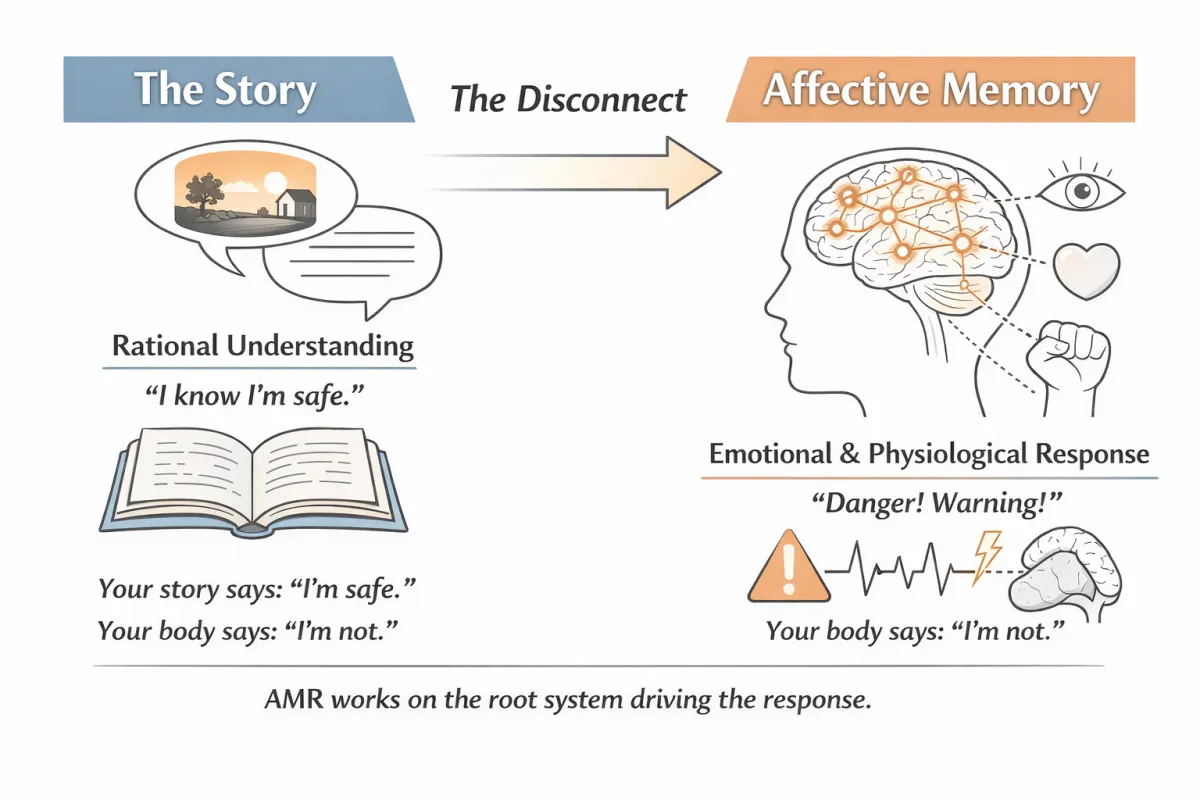
How Affective Memory Resolution works
AMR is built around the neuroscience of emotional learning and memory reconsolidation. The model focuses on the conditions required for a previously encoded emotional pattern to update.
The three key mechanism blocks are:
Activation - The relevant affective memory must be activated at the level of the nervous system.
Mismatch / Prediction Error - The brain must encounter an experience that contradicts what the old pattern predicts.
Completion / Resolution - The nervous system must register a new outcome so that the old emotional encoding no longer drives the same response.
What changes when affective memory resolves
When the underlying pattern changes, the person does not simply gain more insight. They often experience measurable shifts in baseline physiology and day-to-day functioning. Sleep improves. Emotional reactivity declines. Triggers lose intensity. Relationships become easier. The body no longer behaves as though unresolved danger is still active.
Improved sleep
Reduced triggers
Greater emotional regulation
Lower baseline anxiety
Increased relational ease
More stable nervous system state
Who AMR training is for
Coaches who want to move beyond surface-level mindset work
Clinicians seeking neuroscience-aligned trauma intervention models
NLP practitioners who want mechanism-based methods
High-performance practitioners who need durable emotional change tools
Professionals who want to work without retraumatizing clients
Why practitioners need this model now
The market is changing. Clients are increasingly informed, skeptical of vague transformation language, and looking for approaches that are trauma-informed, neuroscience-based, and outcome-oriented. Practitioners who understand affective memory, reconsolidation, and nervous system change are better equipped to produce durable results and communicate their value with precision.
Symptom management vs causal resolution
Traditional approach
Works primarily with story
Prioritizes insight
Often teaches coping strategies
May reduce symptoms temporarily
Can leave underlying pattern intact
AMR approach
Works with affective memory
Prioritizes mechanism
Uses reconsolidation principles
Targets pattern resolution
Produces physiology-based change
Built on neuroscience-informed principles
AMR is informed by research in emotional learning, memory reconsolidation, and nervous system change. It aligns with what is now understood about how emotionally encoded responses are formed, maintained, and updated. For professionals who want a clinically serious and practically usable model, this creates a bridge between theory and application.
Frequently asked questions about AMR
What is Affective Memory Resolution?
Affective Memory Resolution is a neuroscience-based approach that works to resolve emotionally encoded memories by using the principles of activation, mismatch, and reconsolidation.
Is AMR the same as talk therapy?
No. AMR does not rely primarily on narrative processing or insight. It works directly with the nervous system and affective encoding.
Do clients have to relive trauma?
No. The goal is not re-exposure. The goal is resolution through safe and structured updating of the encoded pattern.
What are the signs that a memory has resolved?
Common markers include improved sleep, reduced triggers, less emotional reactivity, and a more stable baseline state.
Who is AMR training for?
AMR training is designed for coaches, clinicians, NLP practitioners, and professionals who want a mechanism-based approach to trauma resolution and emotional change.
Want to know whether this training is right for you?
If you are a coach, clinician, or practitioner looking for a more precise and effective way to work with trauma, emotional reactivity, and nervous system dysregulation, the certification page is the best next step.
From understanding trauma to resolving it
Many professionals can describe trauma. Fewer know how to work with the exact mechanism that keeps it active. The difference is not academic. It determines whether outcomes are temporary or durable. AMR is designed for practitioners who want to operate at the level where real change occurs.
Take the next step
If you want to learn a structured, neuroscience-aligned method for resolving affective memory and helping clients produce measurable change, visit the certification page and review the training details.

FOLLOW US ON


SERVICES & PRODUCTS
LEGAL
Copyright 2026. Inspyrd Inc. All Rights Reserved.