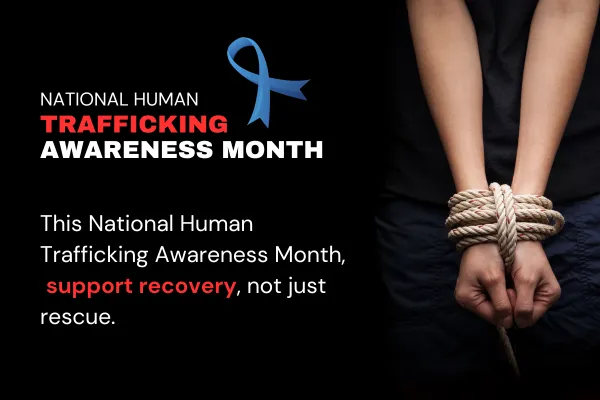
Human Trafficking Awareness Is Incomplete If We Don’t Talk About What Happens After Escape
January is Human Trafficking Awareness Month in the United States. In Canada, February 22 marks our National Day of Awareness. During these periods, the public conversation quite rightly focuses on recruitment—how people are groomed, coerced, and exploited, often by someone they already know.
That education matters. It saves lives.
But awareness that ends at recruitment is only a partial truth.
The question we rarely ask—publicly, systemically, or comfortably—is this: What actually happens after someone escapes human trafficking?
Having worked for years with people impacted by severe trauma, including women who survived human trafficking, I can say this plainly: escape does not equal recovery.
Human trafficking is not a single traumatic event. It is prolonged, interpersonal, coercive trauma—the kind that fundamentally reshapes how the nervous system functions. When someone lives in survival mode for months, years, or decades, their brain and body adapt in order to endure the environment they are trapped in.
Hypervigilance becomes normal. Emotional shutdown becomes protective. Compliance, dissociation, or volatility become strategies—not character flaws.
Those adaptations don’t disappear just because the physical danger is gone.
This is where much of our current awareness narrative quietly breaks down.
Research on complex trauma consistently shows that long-term exposure to coercive environments is associated with enduring changes in stress regulation, emotional processing, and relational capacity—not because people are “broken,” but because their nervous systems learned what was required to survive (Herman; van der Kolk).
And yet, once a woman escapes human trafficking, the services available to support recovery are often short-term, fragmented, or mismatched to the neurobiology of trauma.
We have emergency shelter. We have crisis intervention. We have well-intentioned talk-based therapy.
What we rarely have—at scale—are high-efficacy, trauma-specific, nervous-system-informed recovery pathways designed for long-duration trauma.
This gap matters.
Because trauma does not stay contained within the individual.
It shows up in relationships. In parenting. In employment. In trust, regulation, and consistency.
When survivors struggle in these areas, the narrative often shifts—quietly—from compassion to judgment. Difficult behavior. Lack of motivation. Poor choices.
But decades of trauma research tell a different story.
Survivors of prolonged interpersonal trauma show higher rates of PTSD, dissociation, depression, and ongoing regulation challenges even years after exit, particularly when recovery support focuses on insight alone rather than physiological regulation (Ottisova et al.).
We would never expect someone with a serious physical injury to return to full function without rehabilitation.
Yet we routinely expect survivors of human trafficking to “move on” without addressing the underlying nervous-system injury.
That expectation is not just unrealistic. It is re-traumatizing.
Awareness, if it is to mature, must evolve into responsibility.
Prevention matters—but so does recovery. Rescue matters—but so does restoration.
Neuroscience increasingly demonstrates that sustainable trauma recovery requires interventions that directly engage regulation, safety, and capacity-building at the nervous-system level—not just narrative insight or willpower (Porges; Foa et al.).
If we genuinely want to reduce recidivism, relational breakdown, and long-term dependency, we must invest in approaches that help survivors rebuild internal stability, not just external safety.
Otherwise, awareness becomes performative.
And survivors deserve more than that.
This is why initiatives like the INSPYRD Angels Pilot Initiative exist—to rigorously explore and evaluate recovery approaches that are trauma-informed, nervous-system-based, and grounded in real-world application for women who have survived human trafficking.
Not hype. Not savior narratives. Just a commitment to understanding what actually helps people reclaim a life after prolonged trauma.
Because escape is not the end of trauma. It is the beginning of healing.
Please contact [email protected] to receive your copy of “Inspyrd Angels: A Pilot Initiative Exploring a Neuroscience Informed Coaching Protocol for Survivors of Human Trafficking”
---
Enjoy this? Share the post with others, and follow me, Allen Kanerva, for more.
Want to learn more on healing trauma?
Subscribe to my YouTube community today: https://www.youtube.com/@allen.kanerva
